Back to top

Leicestershire Adult Learning Service – Accountability Statement 2026-27

This statement was last reviewed: July 2026

LALS Accountability Statement 2026-27 (995KB)

1. Statement of Purpose

Leicestershire County Council’s Adult Learning Service (LALS) aims to engage adults into learning and support them develop, knowledge, skills and behaviours that promote access to opportunity and wellbeing.

Strategic Goals

LALS provision supports the delivery of outcomes identified within the Leicestershire County Council Strategic Plan 2022-26, contributing to the following strategic themes:

  1. Improved Opportunities
  2. Strong Economy, Transport & Infrastructure
  3. Clean & Green
  4. Great Communities
  5. Safe & Well
LALS Mission Statement

The Leicestershire Adult Learning Service (LALS) is committed to improving the lives of people across Leicestershire by harnessing education as an enabler for social mobility and enhanced life opportunities. Our approach centres on providing access to educational resources, empowering individuals to expand their horizons and realise their potential through learning.

LALS actively contributes to the delivery of the county council’s strategic themes by forming positive partnerships with employers, agencies, voluntary organisations, and service providers. Our learning activities are community and employer driven, ensuring that the evolving needs of Leicestershire’s residents are effectively met.
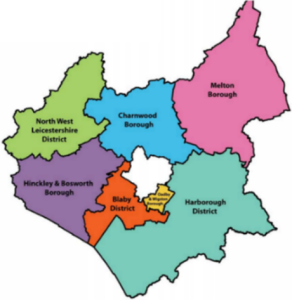
 

2. Context and Place

A map showing the districts of Leicestershire

The county that LALS serves is predominantly rural by area, but urban by population. The total population of the county is 745,573 (ONS mid-year estimates 2023) with 77.7% of the population aged 20 or over, compared to 76.9% for England.

The population is ageing and becoming more ethnically diverse.

The county experienced a 9.5% increase in population between the 2011 – 2021.

Census data shows the demographic profile is changing, proportionally older and more ethnically diverse.

In August 2025, 2.4% of the working age population of the county were claiming out of work benefits compared to 3.6% in the East Midlands and 4.1% in England.

Charnwood experienced the highest overall number of Universal Credit (UC) claimants in August 2025, with 2,897 claimants, followed by Hinckley and Bosworth with 1,783.


Employment and unemployment:                                                                                                                                                                                                                                      Date: July 2025

Leicestershire

Leicestershire East Midlands Great Britain

(numbers)

(%) (%)

(%)

All people
Economically active†

371,900

81.6

77.8

78.8

In employment†

365,100

80.0 74.7

75.5

Employees†

311,600

69.1 66.2

65.7

Self employed†

51,100

10.6 8.4

9.5

Unemployed§

6,700 1.8 3.9

4.1

Source: ONS annual population survey

† Numbers are for those aged 16 and over, % are for those aged 16-64

§ Numbers and % are for those aged 16 and over. % is a proportion of economically active

35.3% of those economically inactive in Leicestershire are students which is significantly higher than the average for Great Britain 26.5%.

Local Industries and Professions
  • There is a high percentage of employees in manufacturing jobs located in Melton, and Hinckley and Bosworth, compared with other types of employment.
  • Northwest Leicestershire has a high percentage of transport and storage related jobs.
  • Charnwood has a high concentration of workers in the education industry, followed by manufacturing.
  • Blaby has a high percentage of employees in professional, scientific and technical jobs.
Educational Attainment

Leicestershire compares positively against the East Midlands and Great Britain for the qualifications achieved up to Level 3.  In 2024, 90.7% of 16-64-year-olds had achieved a level 2 or higher and 70.4% level 3, compared to 86.5% for level 2 and 67.6% nationally for level 3.  However, 44.6% of people achieve a level 4 or above which is below the Great Britain level of 47.2%.

Key Priorities

Priorities identified for the next academic year are informed by a number of key strategies and local plans including:

  • Delivering Wellbeing and Opportunity in Leicestershire Adults & Communities 2025–2029.
  • Get Leicester, Leicestershire and Rutland Working 2025-35, Leicester and Leicestershire Local Plan.
  • Local Skills Improvement Plan.
Get Britain Working - Local Plan

Local Get Britain Working plans are central to the Government’s ambition for a thriving labour market where everyone has the opportunity for good work and to get on in work and where we achieve the ambition of an 80% employment rate.  Adult learning courses will support adults build confidence and develop skills to help them find sustainable employment.  The service offer will be strengthened by the introduction of the Connect to Work programme which will support adults with additional needs.

Leicestershire Local Skills Improvement Plan

The Leicester and Leicestershire Local Skills Improvement Plan (LLSIP), published by East Midlands Chamber, highlights some key areas impacting business growth:

  • Knowledge: across all sectors, technical and vocational knowledge areas are the most important to a business’s success. The next top four identified knowledge requirements are: basic literacy, basic numeracy, health and safety, basic IT.
  • Skills: teamwork is identified as the most important skill across all sectors, followed by, verbal and written communication, specific occupational skills, and time management. In addition to technical and vocational knowledge and skills, employers highly value basic numeracy and literacy.
  • Behaviours: employers prioritise positive behaviours above knowledge and skills, especially teamwork, hard work, reliability, resilience, and honesty.


3. Planning Cycle

Together with specific programme planning parameters, the Accountability Statement provides the framework for curriculum teams to design a learning offer that meets local priorities.

Planning parameters are customised to deliver a financially viable service within the available funding. The service fees policy guarantees consistent course pricing and provides access to fee remission and learner support funds to minimise barriers to learning. Where appropriate, full cost recovery programmes are included in the learning offer to help cover service overheads and generate additional income.

The final stage of planning involves scrutiny by senior leaders to assess the rationale for each course in the programme offer. Before approval, consideration is given to:

  • Alignment with the service ‘Intent’ and strategic goals
  • Outcomes, including progression into employment, further learning, volunteering, personal development, and wellbeing
  • Alignment with the Local Skills Improvement Plan (LSIP)
  • Learner progression pathways and links to other programmes
  • Geographical coverage and accessibility
  • Effective use of resources and course viability
  • Careers Information, Advice, and Guidance requirements
Stakeholders and Partners

Key partners involved in shaping the learning offer include:

  • Local groups and residents
  • Existing service users
  • DWP/Job Centre Plus
  • Voluntary Sector Organisations
  • Work and Skills Forum
  • Get Leicester, Leicestershire and Rutland Working Project Board
  • Schools, Academies, and Early Years Providers
  • Regional Education Providers
  • Employers and representative bodies
  • Libraries, Arts, and Museums
  • Elected Members

To support effective learner progression and minimise duplication we will strengthen our partnerships with stakeholders such as further education colleges, voluntary organisations, and council services.

Leicestershire Adult Learning Service - Programme Priorities 2026/27
Strategic Plan Programmes contributing towards National, Regional and Local Priorities for Learning and Skills Why are we doing it?
Improved

Opportunities

  • In partnership with schools, academies and LCC Children and Family Welfare Services, we will provide 760 places for those wishing to participate in family learning programmes. Courses will be targeted at more deprived areas where they can have most impact on improving opportunities for adults and children.  These programmes will equip parents with the skills they need to effectively support their children’s education and development.
  • We will continue to prioritise basic skills programmes focusing on Digital, English, maths. The programme offer will aim to engage 930 learners into introductory courses such as the Essential Digital qualification and English and maths. These programmes will provide individuals with the foundations they need to support them in their personal or professional life and lead to functional skills qualifications.
  • Our Learning for Independence programme will support 360 individuals with additional needs. The programme will focus on enabling learners to improve health and wellbeing, increase independence and self-advocacy, engage with and be active in the community, progress to identified positive destinations including transition from Children’s and Social Care services.
  • English for speakers of other languages (ESOL) programmes will support language progression from pre-entry to level 2 providing 470 places.
  • We will integrate Information Advice and Guidance (IAG), to support career development plans.
  • LCC Children and Families Partnership Plan aims: to ensure children receive the best start in life, are safe and free from harm and support families to be resilient and self-sufficient. There are a range of benefits to parents from family learning including, the development of basic skills in English, maths, parenting skills, self-esteem, self-confidence.
  • These basic skills courses will be targeted towards disadvantaged groups which will help them progress to positive destinations whether this be entering employment, career progression or going into further or higher education.
  • Our employability classes are often based at employer’s premises where we support organisational change. Part of these courses is signposting individuals to employment support, such as JCP, further learning or advice.
  • The Learning for Independence programme is a discrete service for learners with additional needs. Courses develop learner independence in everyday life reducing demand on carers and support services. Courses also develop the behaviours and attitudes that enhance learners’ abilities to positively represent themselves and contributed to the local community.
  • To succeed at Level 3 and beyond, several steps can be required whether it be baseline literacy and numeracy or other steps to enable this, for example digital skills or more general Preparation for Life and Work courses which can be pre-level 1 and are the most popular courses for adults.
Strong Economy, Transport and

Infrastructure

  • Work Based Learning programmes will contribute positively to local economic growth.
  • We will expand our apprenticeship programme and enrol an additional 50 Apprentices onto a range of different subject specialisms including, Payroll, Social Care, Teaching and Learning and Business Administration and Management. We will attain an overall achievement rate of at least 80% for our Apprenticeship programme.
  • Our Work and Skills Leicestershire programmes will support unemployed or those at risk of losing their job find sustainable employment and we will continue to prioritise these programmes.
  • LALS will deliver the county Supported Employment Quality Framework (SEQF) element of the Connect to Work (CTW) programme which will support disabled people, those with health conditions and people with multiple and complex barriers to move into and maintain employment.
  • We will attain an overall learner achievement rate of 84% for our adult skills programme by providing high quality teaching and learning and the necessary additional learning support required to help disadvantaged target groups succeed.
  • Activities map to priorities identified within Local Skills Improvement Plan (LSIP) priorities and Leicester and Leicestershire Business and Skills Partnership.
  • Adult learning apprenticeships will support the delivery of a highly skilled workforce, and these programmes will contribute to the wider workforce strategy to recruit to posts that are hard to fill. For example, within adult social care
  • Local Get Britain Working plans are central to the Government’s ambition for a thriving labour market where everyone has the opportunity for good work.
  • Designed to tackle economic inactivity, Connect to Work has a key role in delivering the outcomes of Get Britain Working.
  • According to recent surveys conducted with local employers, Digital skills were identified as a barrier to productivity.  Poor digital skills also limit individuals’ ability to access services and can limit opportunities for career progression.
Clean and Green
  • LALS curriculum offer will include activities to raise awareness of sustainable living and promote the protection of our natural environment.
  • We will deliver a range of courses to help people minimise their impact on the environment.
  • Community courses will raise awareness on how individuals can improve their quality of life by connecting and protecting the environment in which they live.
  • We will increase opportunities for learning online to reduce the need for learners to travel to centres with 15% of learners participating remotely.
  • Where possible we will use environmentally friendly and sustainable learning resources across the curriculum.
  • Take action to reduce their environmental impacts, such as by being more resource-efficient and travelling by sustainable modes. LCC Strategic Plan 22-26
  • There is a requirement to further protect and enhance the area’s rich natural capital assets to generate services which will contribute to long term economic growth and to energy and circular economy practices that will drive clean growth. Leicester and Leicestershire Local Industrial Strategy 2025
  • A key action within the LCC Strategic Plan is to ‘Raise environmental awareness amongst local communities, schools and businesses to promote positive action’ National government has identified the need to reduce food waste which is currently estimated to be 10 million tonnes per year, as a national priority due to the impact on the environment.
Great

Communities

  • We will encourage residents and local businesses to take more control of steering curriculum design by convening engagement events across the county.
  • We will provide more opportunities for local voluntary groups to meet and engage by providing community groups more access to our major centres where these activities support the strategic outcomes of the council.
  • Learning activities support those not in work to develop the skills and confidence required for volunteering and the running of community services.
  • We will continue to support community integration through the delivery of a curriculum that appeals to people from different backgrounds.
  • Our goal is to work with partners to increase community cohesion and tackle hate crime. LCC Strategic Plan 22-26
  • Through their participation in classes, adults leave their programmes with a greater understanding of people, their cultures, and an insight to different perspectives on life.
  • Programmes will help address social isolation by connecting people and promoting social interaction in a safe learning environment where learners with shared experiences can make beneficial and supportive social links.
  • Fundamental British Values will be embedded into all adult learning classes.
Safe and Well
  • We will support people improve their health to enable them to take up employment opportunities and become economically active.
  • Our Learning for Wellbeing and Mental Health programmes will provide a combined output of 790 spaces to support people to support resilience and recovery from poor mental health. We will strengthen links with partners to improve referral from social prescribers and other public health programmes such as Workwell.
  • We will develop a wellbeing offer for employers to support employees struggling with absenteeism due to poor health, either mental or physical.
  • We will create a safe learning environment and embed activities that develop confidence. Through these activities we will promote trust and respect for British Fundamental Values. Our courses will empower individuals to speak up and take control of their own wellbeing.
  • Courses will raise awareness to online safety and actions that can be taken to minimise risks.
  • There are 33,783 residents across LLR who are economically inactive due to long term sickness, representing 22.9% of all inactive adults, highlight the strong connection between health inequalities and labour participation. Get LLR Working Plan 2025-35


  • Our goal is for Leicestershire to have active and inclusive communities in which people support each other and participate in service design and delivery. LCC Strategic Plan 22-26
  • To develop behaviours, attitudes, knowledge, and skills which support learners to improve or maintain their wellbeing and resilience which may also contribute to preventing or reducing the need to access other services is a key priority of the A&C Strategy – Delivering Wellbeing and Opportunity in Leicestershire. LCC aims to work with a range of partners internally and externally to address the wider issues that affect wellbeing and health. LCC Public Health Strategy 2022-27
  • Improving digital skills can reduce social isolation and reduce the impact this has on wellbeing, particularly in the more rural parts of the county.


Corporation Statement/Sign-off

On behalf of Leicestershire County Council.

Name: Councillor Kevin Crook

Date:   2nd July 2026

The plan will be published on the Council’s website within three months of the start of the new academic year.